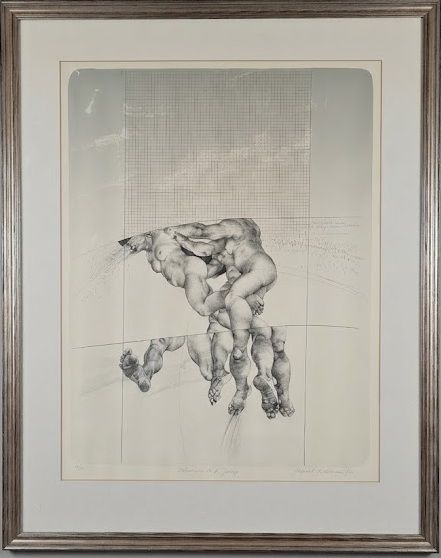
Lithograph by the Czech artist Oldřich Kulhánek, titled "Interior No 3 Jump" from 1980
€800,00
Price incl. btw (21%) €138,84
Collectie item van Art Institute of Chicago en Centre Pompidou
In stock: 1 available
Product Details
This artwork is a lithograph by the Czech artist Oldřich Kulhánek, titled "Nebe, peklo, ráj" (Heaven, Hell, Paradise) from 1980. It is a representative example of his work from this period, in which he explored the human figure and anatomy in a surrealist and often existential manner.
Characteristics of the work Theme: The work depicts intertwined, anatomically detailed torsos and legs that appear to float or fall against an abstract, rasterized background. This "torso style" is characteristic of Kulhánek’s exploration of the vulnerability and strength of the human body.
Technique: It is a lithograph (stone print). Kulhánek was known for his technical perfection and the ability to approach the fineness of an etching with lithography.
Edition: 30/60
Size: The paper size is typically approximately 65 x 50 cm.
Historical Context In 1980, when this work was created, Kulhánek was officially prohibited from exhibiting in his own country (then Czechoslovakia) due to previous problems with the communist regime.
This forced him into a very introspective and symbolic style, in which the distortion of the human body often served as a metaphor for the societal pressure he experienced.
Lithograph by the Czech artist Oldřich Kulhánek, titled "Interior No 3 Jump" from 1980
Display prices in:EUR